
 Proudly Canadian
CAD$44.99
This product is intended for laboratory and research use only. Not for human consumption or veterinary use.
55 in stock
Choose your payment method at checkout: credit card or Interac e-Transfer.
Pay instantly by card, or send an e-Transfer to support@bioperform.ca and save 3%.
Orders before 2PM MST ship same day. Tracking number included.
Email support@bioperform.ca. Always a real response.
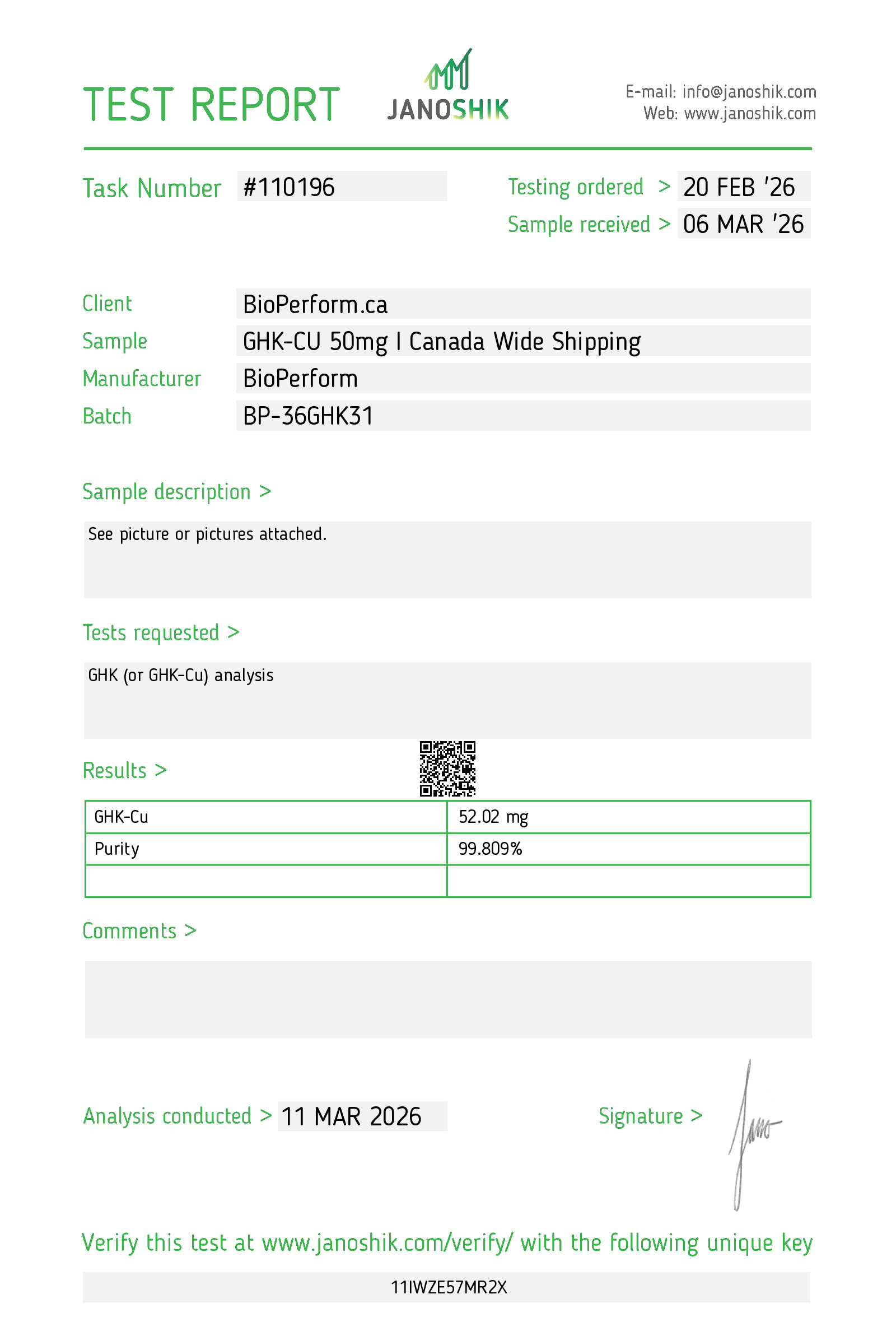
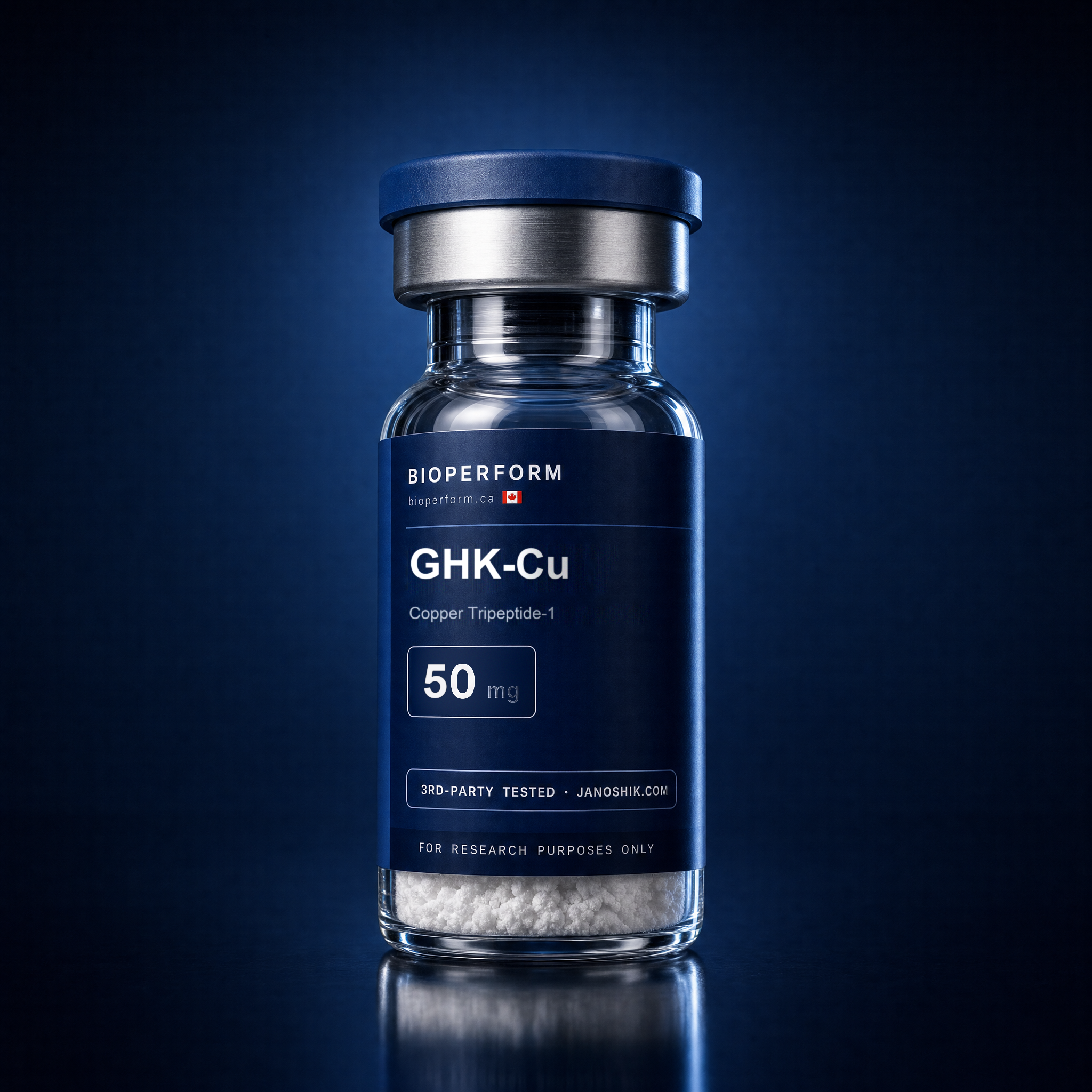
GHK-Cu 50mg is a well-established copper-binding peptide widely used in dermatology, cellular biology, and regenerative science research. It is primarily investigated for its role in collagen synthesis, extracellular matrix remodeling, wound-healing signaling pathways, anti-inflammatory activity, and hair follicle biology.
As one of the most extensively studied peptides in skin-related research, GHK-Cu is commonly used in fibroblast and keratinocyte models to explore how skin cells maintain structure, respond to stress, and regulate repair processes. Its ability to bind copper ions makes it an important compound for studying copper-dependent enzymatic and signaling pathways in biological systems.
GHK-Cu is widely studied for its ability to influence collagen and elastin pathway markers in dermal fibroblast models. These two structural proteins are essential for maintaining skin strength, elasticity, and overall tissue integrity.
In laboratory studies, researchers use GHK-Cu to examine how fibroblast cells regulate extracellular matrix production and how structural proteins are expressed under different experimental conditions. This makes it a core compound in dermal tissue engineering and skin biology research.
One of the earliest and most frequently studied applications of GHK-Cu is in wound-healing biology. Researchers investigate its role in cellular repair signaling, tissue regeneration pathways, and re-epithelialization processes in skin cell models.
GHK-Cu is often used in experimental systems designed to simulate tissue injury and recovery, allowing scientists to better understand how skin cells coordinate repair responses and restore structural integrity following biological stress.
In dermal cell research, GHK-Cu is frequently studied for its potential involvement in anti-inflammatory and antioxidant signaling pathways. These pathways are critical in protecting cells from oxidative stress and maintaining tissue balance under environmental or physiological stress conditions.
Researchers examine how GHK-Cu may influence cytokine signaling, reactive oxygen species (ROS) regulation, and inflammatory mediator expression within skin and connective tissue models.
GHK-Cu is also widely used in hair follicle and dermal papilla research. Scientists study its effects on follicular cell activity, signaling pathways involved in hair growth cycles, and structural maintenance of hair follicles.
These studies are often conducted in vitro using follicular cell models to explore how copper-dependent peptides may influence hair biology and skin appendage function.
GHK-Cu is commonly utilized in laboratory studies involving:
These applications make GHK-Cu a versatile compound across dermatology, molecular biology, and regenerative medicine research fields.
GHK-Cu functions as a copper-binding peptide, meaning it can interact with copper ions that are essential cofactors in many biological processes. In research settings, this property is used to study how copper influences enzyme activity, gene expression, and cellular signaling.
Because copper is involved in collagen formation, antioxidant defense, and tissue repair mechanisms, GHK-Cu provides a valuable model for investigating how trace metals regulate biological systems at the cellular level.
In experimental settings, GHK-Cu stability and activity can be influenced by environmental conditions. Researchers often evaluate how pH levels, temperature, and chemical interactions affect peptide integrity.
It is commonly noted in research environments that copper peptides may be sensitive to strong oxidizing agents. For this reason, experimental design typically considers compatibility with other compounds to ensure accurate results in in vitro and in vivo models.
Best For: Dermal tissue research, wound biology, collagen synthesis studies, and hair follicle biology.
Use Case: Investigating extracellular matrix remodeling, fibroblast signaling, and skin regeneration pathways in laboratory models.
Research Advantage: One of the most extensively studied copper peptides, widely used as a reference compound in skin and connective tissue research.
GHK-Cu 50mg is intended strictly for laboratory and scientific research purposes. It is not for human consumption and is not approved for medical use, diagnosis, treatment, or prevention of any disease.
This product is intended for use only by qualified researchers and licensed laboratories. It has not been evaluated or approved by Health Canada or any other regulatory authority for therapeutic use.
GHK-Cu is a naturally occurring copper-binding peptide that is widely studied in dermatology and regenerative biology research. It plays a role in cellular signaling, tissue repair pathways, and extracellular matrix regulation.
In laboratory studies, GHK-Cu is used to investigate collagen synthesis, elastin production, wound-healing pathways, oxidative stress response, inflammatory signaling, and hair follicle biology.
GHK-Cu is widely studied in dermatology, molecular biology, regenerative medicine, wound-healing research, and cosmetic science-related laboratory models.
No. GHK-Cu 50mg is strictly for laboratory research purposes only and is not approved for human consumption or therapeutic use.
Copper is a vital trace element involved in many enzymatic reactions, including collagen formation and antioxidant defense. GHK-Cu allows researchers to study how copper influences biological signaling pathways.
Only logged in customers who have purchased this product may leave a review.



I pair GHK-Cu with occasional microneedling and recovery is so much quicker. Redness fades faster and my skin settles into a really nice glassier look afterward.
I’ve noticed that little marks and minor skin irritations fade faster than they used to. My skin doesn’t stay red and inflamed as long.
Old marks have been fading more quickly since I started this. Instead of hanging around for months they mellow out in a few weeks.
I’ve been using GHK-Cu consistently and my complexion looks more even. Old sun damage patches have lightened and overall tone is less blotchy.
GHK-Cu has made my overall tone brighter and more even. Just a healthier looking complexion with fewer bad skin days overall.
My skin feels more hydrated from within. Even on days I forget my moisturizer my face doesn’t look as dry or tight as it used to.