
 Proudly Canadian
CAD$54.99
This product is intended for laboratory and research use only. Not for human consumption or veterinary use.
43 in stock
Choose your payment method at checkout: credit card or Interac e-Transfer.
Pay instantly by card, or send an e-Transfer to support@bioperform.ca and save 3%.
Orders before 2PM MST ship same day. Tracking number included.
Email support@bioperform.ca. Always a real response.
KPV 10mg is a synthetic tripeptide derived from the C-terminal region of alpha-melanocyte stimulating hormone (α-MSH). Composed of the amino acid sequence Lysine-Proline-Valine, KPV has emerged as a notable research compound in studies involving inflammatory signaling, epithelial barrier function, and immune pathway regulation.
Unlike larger peptides that interact with multiple biological systems simultaneously, KPV offers researchers a focused model for investigating inflammation-related cellular activity. Its small molecular structure and demonstrated activity across gastrointestinal, dermal, and immune-related research models have made it a valuable tool in preclinical investigations.
Today, the KPV peptide is frequently examined in laboratory settings where researchers seek to better understand how inflammatory responses influence tissue integrity, cellular communication, and barrier function.
Inhibits NF-kB, one of the body’s main inflammatory signalling switches, in systemic inflammation research models. A well-studied mechanism for understanding how inflammatory pathways can be modulated.
Uses the PepT1 transporter to reach intestinal mucosal cells, investigated for effects on gut lining integrity and intestinal permeability models.
In vitro antimicrobial activity was observed against dermal pathogens, studied in inflammatory skin cell models.
Investigated for pathogen neutralisation mechanisms in immune pathway models, without documented suppression of baseline immune response.
KPV originates from alpha-MSH, a naturally occurring neuropeptide known for its involvement in immune regulation and inflammatory signaling. Researchers became interested in the KPV fragment after discovering that certain biological activities of alpha-MSH could be retained within this shorter amino acid sequence.
This discovery led to growing interest in KPV as a standalone research peptide. By isolating a smaller active fragment, scientists gained a more targeted way to investigate specific pathways associated with inflammation and tissue response mechanisms.
The peptide continues to be explored as a model compound for understanding how small peptide fragments may influence biological signaling at the cellular level.
The gastrointestinal tract contains one of the body’s most complex barrier systems. Researchers studying intestinal permeability and mucosal integrity frequently investigate compounds capable of reaching epithelial tissues directly.
KPV has attracted attention because it utilizes the PepT1 peptide transporter, allowing researchers to examine how peptide-based compounds interact with intestinal mucosal cells. This characteristic has positioned KPV as a common inclusion in studies involving epithelial barrier function and gastrointestinal inflammatory pathways.
Inflammatory skin conditions involve a variety of signaling molecules that influence cellular behavior and tissue responses. KPV has been investigated in laboratory models designed to evaluate inflammatory activity within skin cells and dermal tissues.
In vitro findings demonstrating antimicrobial activity against select dermal pathogens have further expanded scientific interest in the peptide’s potential role within skin-related research programs.
Many modern inflammation studies focus on intracellular signaling systems that regulate inflammatory responses. NF-kB remains one of the most widely studied molecular targets because of its role in controlling the expression of numerous inflammation-associated genes.
KPV is often included in experimental models that seek to better understand these signaling networks and their impact on tissue health, immune communication, and cellular stress responses.
Researchers commonly investigate KPV within studies involving:
Its versatility across multiple experimental systems continues to make KPV an attractive compound for laboratory investigation.
KPV is frequently evaluated alongside other peptides that target complementary biological pathways.
One of the most common pairings in peptide research involves KPV and BPC-157. While KPV is primarily investigated for inflammatory signaling mechanisms, BPC-157 is often studied in relation to tissue repair and regenerative processes.
Researchers exploring gastrointestinal models frequently include both compounds when examining barrier integrity, tissue response, and cellular recovery pathways.
This ongoing interest has made KPV vs BPC-157 a common discussion point within peptide research communities, though the two compounds are generally viewed as complementary rather than competitive.
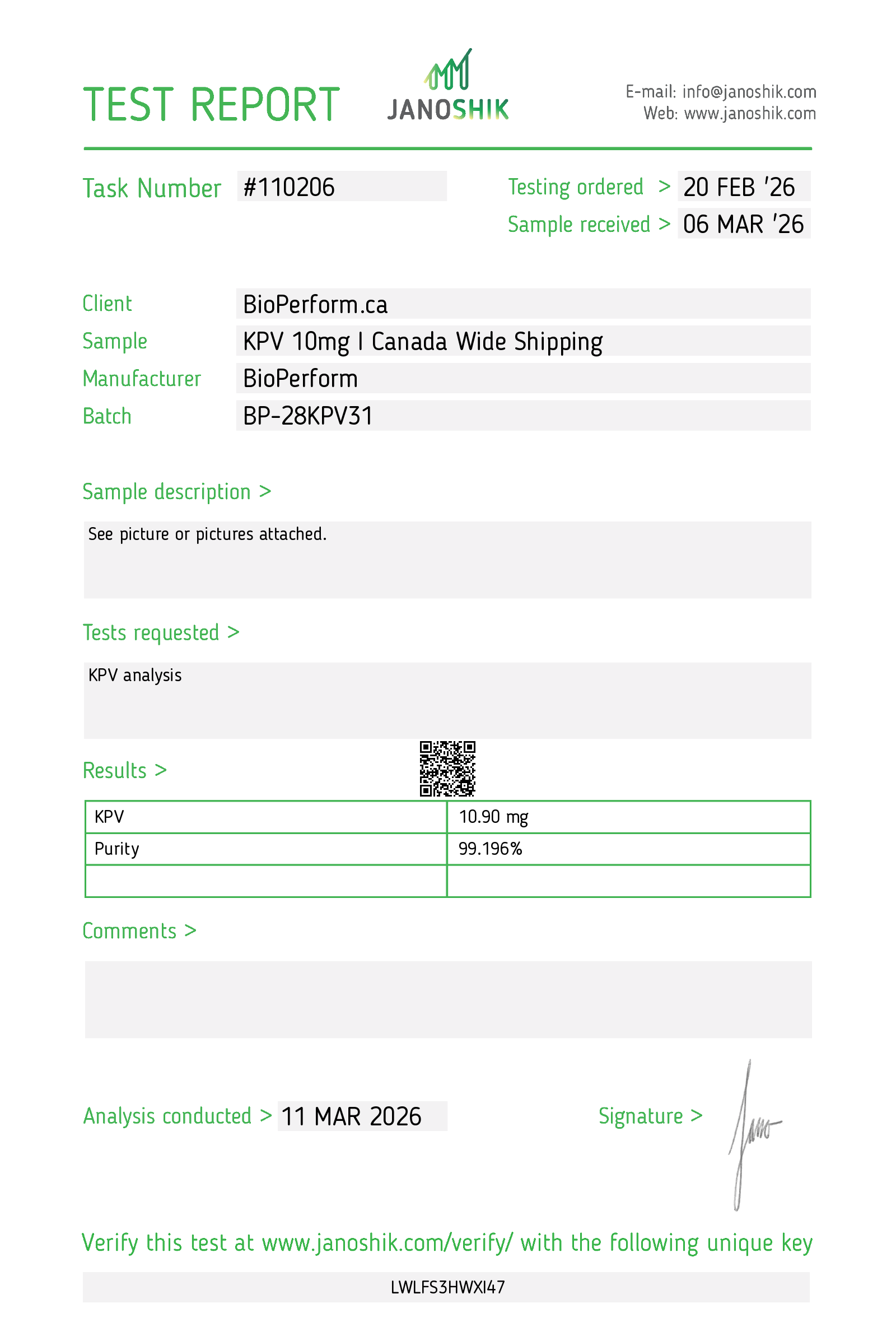
Product Name: KPV 10mg
Peptide Classification: Alpha-MSH Fragment Peptide
Sequence: Lysine-Proline-Valine (KPV)
Format: Lyophilized Powder
Purity: Laboratory Grade
Quantity: 10 mg per vial
Application: Research Use Only
Storage: Store according to established peptide handling and laboratory storage protocols.
Each vial of KPV 10mg is produced for research applications requiring consistency, stability, and analytical reliability. Lyophilization helps maintain peptide integrity during storage and transport, allowing researchers to work with a stable compound suitable for controlled laboratory environments.
As demand for high-quality KPV research compounds continues to grow, proper sourcing and handling remain critical factors for obtaining reliable experimental outcomes.
For research purposes only. Not for human consumption. For use by licensed researchers only. These compounds have not been evaluated or approved by Health Canada for human use.
This product is intended exclusively for laboratory research, analytical testing, and scientific investigation. It is not intended to diagnose, treat, cure, or prevent any disease. Researchers are responsible for complying with all applicable regulations regarding the purchase, storage, handling, and use of research compounds.
Only logged in customers who have purchased this product may leave a review.




Has helped incredibly with gut irritation
Started KPV alongside a cleaner diet and the combination has been great. Less gut irritation and I don’t feel as inflamed after eating heavier foods.