
 Proudly Canadian

CAD$59.99
This product is intended for laboratory and research use only. Not for human consumption or veterinary use.
41 in stock
Choose your payment method at checkout: credit card or Interac e-Transfer.
Pay instantly by card, or send an e-Transfer to support@bioperform.ca and save 3%.
Orders before 2PM MST ship same day. Tracking number included.
Email support@bioperform.ca. Always a real response.
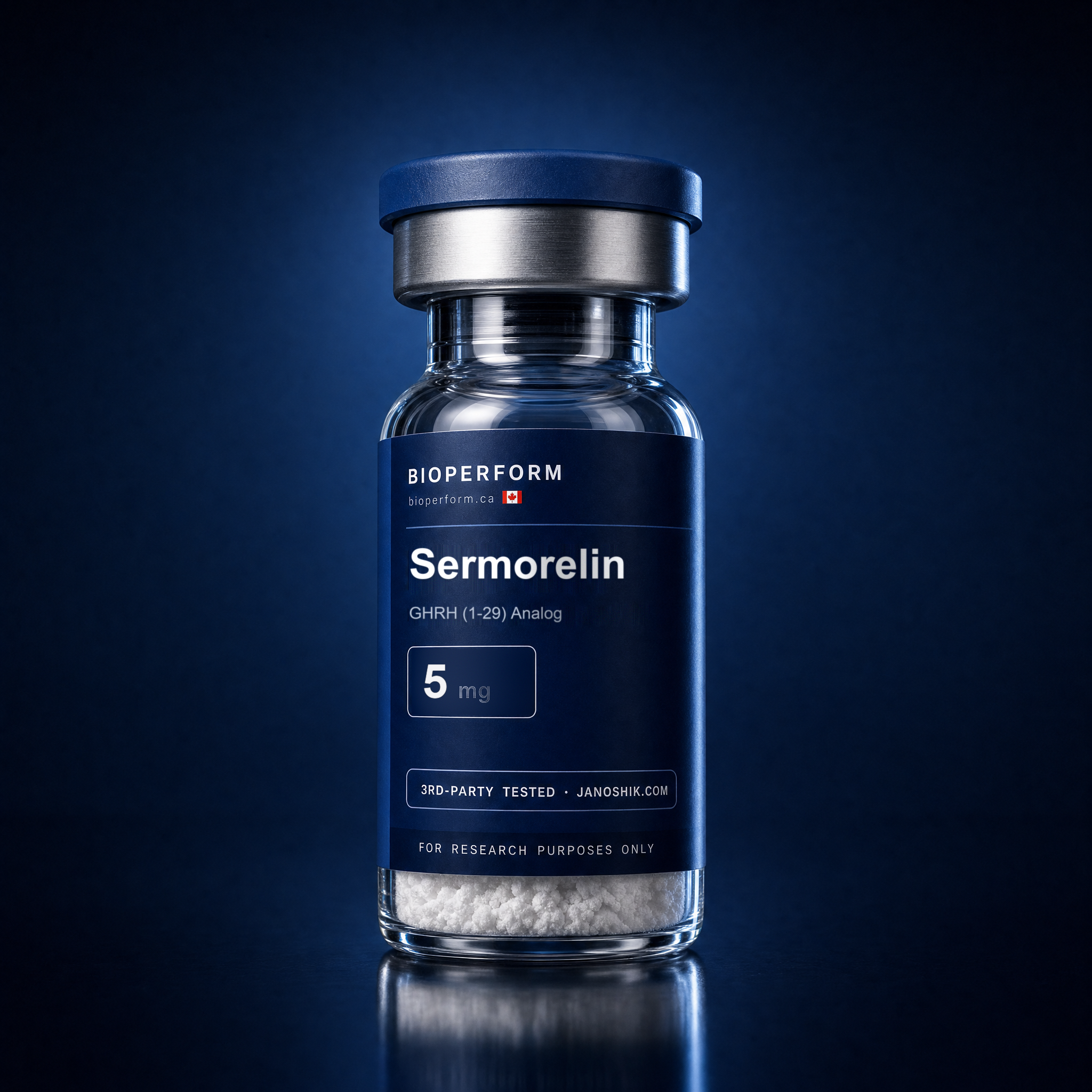
Sermorelin 5mg is a well-characterized Growth Hormone Releasing Hormone (GHRH) analogue widely utilized in endocrine and growth hormone research. Consisting of the first 29 amino acids of the body’s natural GHRH signal, Sermorelin is designed for researchers investigating pituitary growth hormone secretion, neuroendocrine signaling, and GH-mediated biological pathways.
As one of the earliest and most extensively studied GHRH analogues, Sermorelin remains a valuable reference compound in growth hormone secretagogue research. Its established role in laboratory studies makes it a popular choice for researchers exploring growth hormone regulation, tissue signaling, metabolic pathways, and comparative peptide research models.
Sermorelin is frequently selected for studies involving natural growth hormone signaling mechanisms due to its close relationship to endogenous GHRH activity.
Sermorelin is primarily investigated for its interaction with Growth Hormone Releasing Hormone receptors located within the pituitary gland. Researchers utilize Sermorelin to study the biological signaling pathways that regulate growth hormone production and secretion.
Because it closely mimics the body’s natural GHRH signal, Sermorelin is often used in laboratory models designed to evaluate endocrine function and growth hormone-related cellular responses.
Growth hormone signaling influences a wide range of biological processes. In preclinical research, Sermorelin has been studied for GH-mediated effects on extracellular matrix composition, tissue maintenance pathways, and cellular signaling mechanisms.
Researchers frequently incorporate Sermorelin into studies examining how growth hormone pathways influence biological systems involved in tissue structure, cellular communication, and regenerative biology.
Sermorelin is commonly utilized in neuroendocrine research models investigating hormone signaling patterns associated with sleep-related biological processes.
Scientists studying endocrine communication pathways often explore the relationship between growth hormone secretion and neuroendocrine signaling networks to better understand physiological regulation mechanisms.
Preclinical studies have investigated growth hormone-mediated pathways associated with lean tissue composition and subcutaneous adipose regulation. Sermorelin is frequently used in metabolic research models examining how growth hormone signaling may influence body composition-related biological processes.
Its role in endocrine pathway research makes it a useful tool for exploring the interaction between hormonal signaling and metabolic regulation.
Sermorelin is frequently incorporated into studies involving:
Sermorelin is a well-established GHRH analogue that closely mimics natural growth hormone signaling, making it reliable for endocrine research. It is widely used as a reference compound in growth hormone studies.
Its consistency and predictable activity make it useful for comparing GH secretagogue mechanisms in pituitary and metabolic research models.
Best For: GHRH receptor agonism research, pituitary growth hormone secretion modeling, and endocrine pathway studies.
Use Case: A well-characterized GHRH analogue frequently used as a reference compound in growth hormone secretagogue research.
Commonly Studied With: Ipamorelin for combined GHRH and GHRP growth hormone pulse research protocols.
Sermorelin is a Growth Hormone Releasing Hormone (GHRH) analogue consisting of the first 29 amino acids of the body’s natural GHRH peptide.
Researchers frequently study Sermorelin in growth hormone secretion, pituitary signaling, neuroendocrine function, and metabolic pathway research models.
Sermorelin is one of the oldest and most extensively studied GHRH analogues, making it a valuable benchmark for comparative growth hormone secretagogue research.
No. Sermorelin 5mg is supplied strictly for laboratory and scientific research purposes and is not approved for human consumption.
Sermorelin 5mg is intended exclusively for laboratory and scientific research purposes. Not for human consumption, medical use, diagnosis, treatment, or prevention of any disease.
For use by qualified researchers and licensed laboratories only. These compounds have not been evaluated or approved by Health Canada for human use.
Only logged in customers who have purchased this product may leave a review.



Arrived fast for a good price, no complaints
Product arrived quick and packaged nicely. Reasonable prices and very responsive.