
 Proudly Canadian
CAD$69.99
This product is intended for laboratory and research use only. Not for human consumption or veterinary use.
58 in stock
Choose your payment method at checkout: credit card or Interac e-Transfer.
Pay instantly by card, or send an e-Transfer to support@bioperform.ca and save 3%.
Orders before 2PM MST ship same day. Tracking number included.
Email support@bioperform.ca. Always a real response.
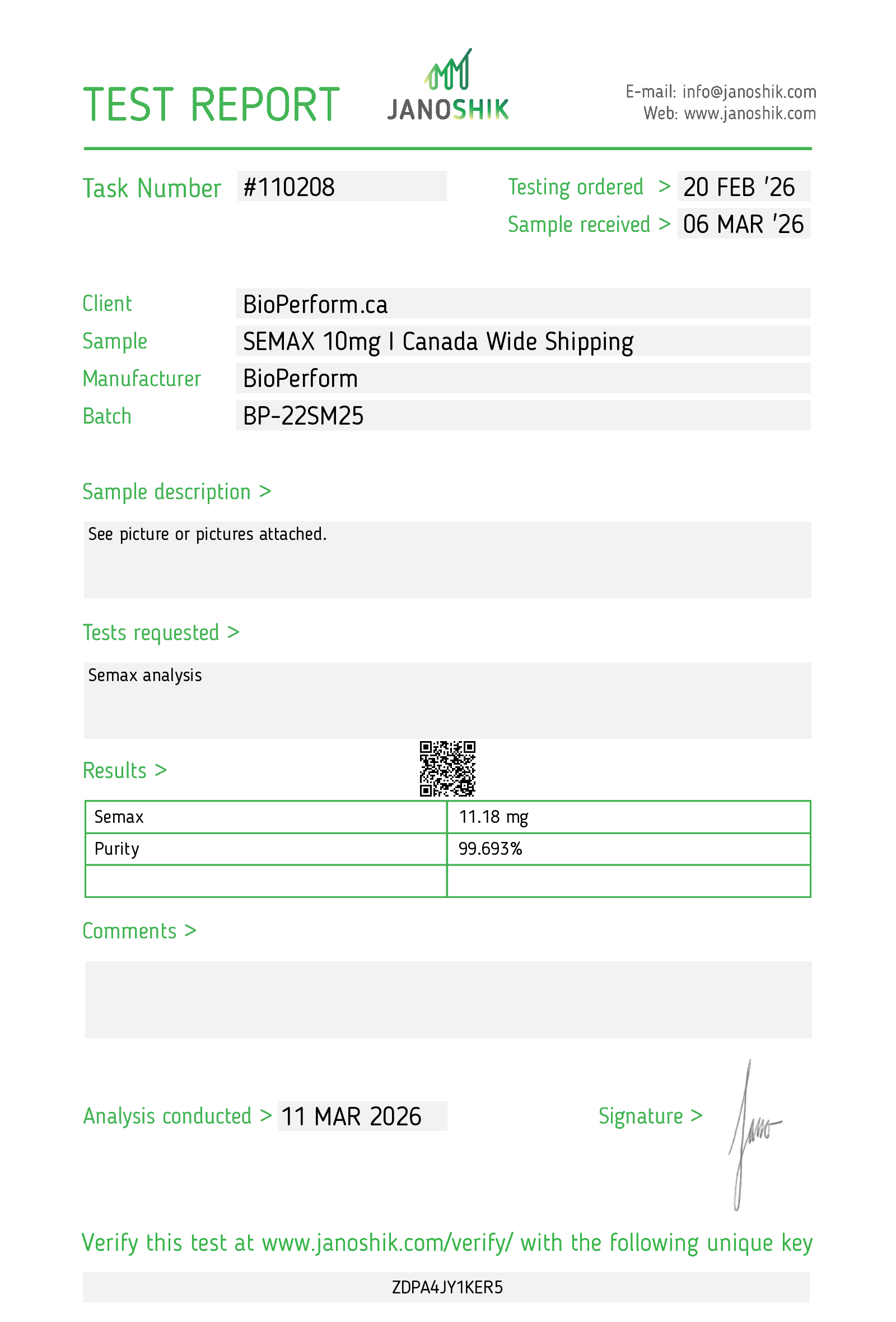
Semax 10mg is a synthetic ACTH-derived peptide widely studied in neuroprotection, cognitive pathway biology, and neurotrophin research. Originally developed as a modified fragment of adrenocorticotropic hormone (ACTH), Semax peptide has attracted significant scientific interest due to its involvement in brain-derived neurotrophic factor (BDNF), nerve growth factor (NGF), and neurotransmitter signaling pathways.
Researchers frequently utilize Semax research compound models to investigate neural communication systems, cognitive function pathways, stress-response mechanisms, and neuroprotective biological processes. With a substantial history in preclinical and experimental neuroscience research, Semax remains one of the most recognized compounds within the neuropeptide category.
The Semax 10mg format provides laboratories with a research-grade peptide suitable for investigations involving neurotrophin regulation, neuronal signaling, and cognitive pathway studies.
Semax is a synthetic peptide derived from adrenocorticotropic hormone and has become a valuable research tool for studying neurobiological signaling systems.
Researchers commonly investigate Semax in studies involving:
Its unique molecular structure and extensive research history continue to support scientific interest in its biological activity.
One of the most widely studied aspects of Semax peptide involves its relationship with neurotrophin signaling pathways.
Research interests include:
Because BDNF and NGF are central components of nervous system research, Semax has become an important reference compound in neurotrophin-related investigations.
Semax has also been extensively evaluated in laboratory models involving oxygen deprivation and cellular stress responses.
Areas of scientific interest include:
These studies continue to contribute to broader scientific understanding of how neural tissues respond to challenging biological conditions.
Researchers frequently investigate Semax for its potential influence on neurotransmitter-related pathways.
Scientific applications commonly include:
Its relevance to multiple neurotransmitter systems has helped establish Semax as a valuable compound for cognitive pathway research.
The popularity of Semax nootropic peptide research stems from several important characteristics:
These factors continue to make Semax one of the most recognized neuropeptides in scientific literature.
Studying neural communication systems and cognitive pathway activity.
Investigating biological mechanisms associated with neuronal survival and resilience.
Examining BDNF, NGF, and related growth factor signaling pathways.
Understanding executive function, learning, memory, and neural adaptation processes.
Exploring interactions between hormonal signaling and nervous system biology.
| Specification | Details |
| Product Name | Semax |
| Quantity | 10mg |
| Category | ACTH-Derived Peptide |
| Format | Lyophilized Research Peptide |
| Research Focus | Neuroprotection and Cognitive Research |
| Alternate Category | Nootropic Research Peptide |
| Intended Use | Laboratory Research Only |
Investigating ACTH-derived peptide activity and its relationship to neurotrophin expression, neurotransmitter pathways, and cognitive signaling mechanisms.
Researchers frequently evaluate Semax alongside Selank when examining complementary neural communication systems and cognitive pathway interactions.
Semax provides researchers with a well-characterized ACTH-derived peptide model for studying neuroprotection, neurotrophin regulation, and executive function-related biological pathways.
To maintain peptide stability and integrity, laboratories should follow established storage and handling procedures.
General recommendations include:
Proper storage and handling help support consistency throughout research projects.
Semax is a synthetic ACTH-derived peptide commonly studied in neuroprotection, cognitive pathway biology, and neurotrophin research.
Researchers investigate Semax in studies involving BDNF and NGF regulation, neurotransmitter signaling, neuroprotection, cognitive function, and neural communication pathways.
Semax is often classified as a Semax nootropic peptide because researchers frequently study its role in cognitive signaling pathways and executive function-related biological processes.
In Semax vs Selank research comparisons, the compounds are typically evaluated for different but complementary neural signaling mechanisms and neuroscience applications.
No. Semax 10mg is supplied exclusively for laboratory research, analytical testing, and scientific investigation purposes.
Semax 10mg is intended strictly for laboratory research and scientific investigation. This product is not intended for human consumption, medical treatment, therapeutic use, or diagnostic application. Researchers are responsible for complying with all applicable regulations, safety standards, and laboratory protocols.
For research purposes only. Not for human consumption. For use by licensed researchers only. These compounds have not been evaluated or approved by Health Canada for human use.
Only logged in customers who have purchased this product may leave a review.


Semax has helped with overall mental clarity. I feel more present, less scattered, and better able to juggle multiple things without feeling overloaded.
Using it a few times a week and the cumulative effect is noticeable. Sharper memory, better concentration, and less of that drained feeling by the end of the day.
The main thing I notice is mental stamina. I can do deep focused work for a couple of hours straight without that heavy mental fatigue I usually get.