
 Proudly Canadian
CAD$174.99
This product is intended for laboratory and research use only. Not for human consumption or veterinary use.
2 in stock
Choose your payment method at checkout: credit card or Interac e-Transfer.
Pay instantly by card, or send an e-Transfer to support@bioperform.ca and save 3%.
Orders before 2PM MST ship same day. Tracking number included.
Email support@bioperform.ca. Always a real response.
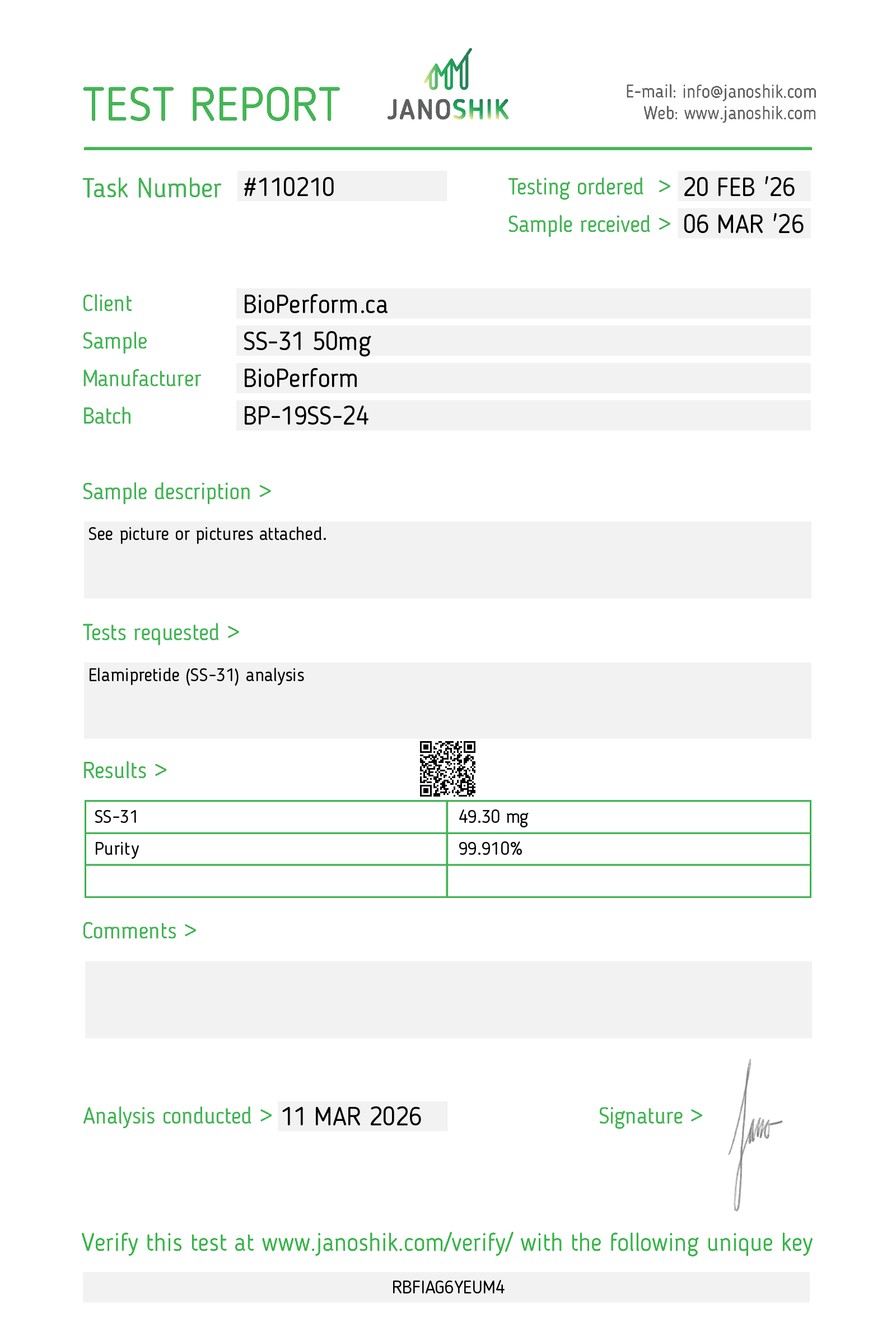
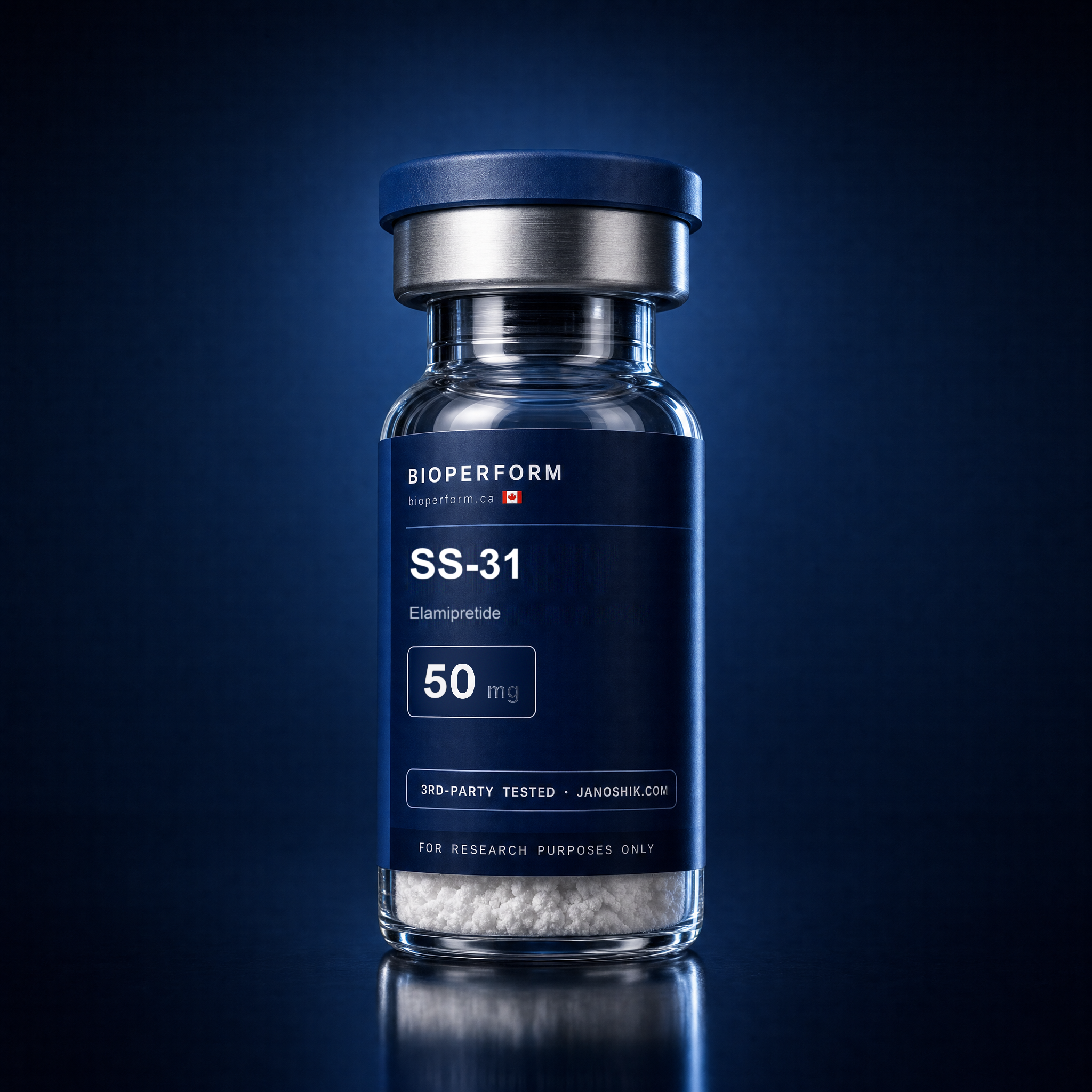
SS-31 50mg, also known as Elamipretide, is a specialized mitochondrial research peptide developed for scientists investigating cellular energy production, oxidative stress, and mitochondrial membrane function. Unlike general antioxidant compounds that focus on managing the effects of oxidative damage, SS-31 is studied for its ability to interact directly with cardiolipin, a critical lipid found within the inner mitochondrial membrane.
This targeted mechanism has made SS-31 one of the most sought-after compounds in mitochondrial biology research. From ATP production and cellular energy studies to organ-level oxidative stress models, researchers continue to explore how this unique peptide may support mitochondrial efficiency and resilience under challenging cellular conditions.
SS-31 is widely recognized as a cardiolipin-targeting peptide. Cardiolipin plays an essential role in maintaining mitochondrial structure and supporting efficient energy production. By focusing on this critical component of the mitochondrial membrane, SS-31 allows researchers to investigate mitochondrial health at its source rather than addressing downstream effects alone.
This unique characteristic sets the mitochondrial peptide SS-31 apart from many other compounds used in cellular energy research.
Excessive reactive oxygen species (ROS) production can disrupt normal mitochondrial function and contribute to cellular stress. SS-31 is commonly studied in oxidative stress models because of its potential ability to reduce ROS generation within mitochondria.
Researchers are particularly interested in how the peptide may help preserve mitochondrial performance under stressful conditions, making it a valuable tool in studies focused on cellular resilience and recovery pathways.
Healthy mitochondria are responsible for producing ATP, the molecule that powers nearly every cellular process. SS-31 has become a leading compound in ATP synthesis research due to its potential involvement in maintaining mitochondrial membrane efficiency.
Scientists frequently utilize SS-31 50mg in cardiac, neuronal, and skeletal muscle cell models to better understand how mitochondrial performance influences cellular energy output and metabolic function.
The effects of mitochondrial dysfunction extend beyond individual cells and can impact entire organ systems. As a result, SS-31 is commonly investigated in heart, brain, and kidney research models where oxidative stress and energy-demanding cellular processes play important roles.
Its broad research potential makes it a valuable addition to studies examining mitochondrial pathways across multiple biological systems.
Researchers continue to choose SS-31 because of its targeted approach to mitochondrial biology. Rather than functioning as a traditional antioxidant, the peptide is studied for its interaction with the mitochondrial membrane itself. This distinction allows scientists to explore fundamental mechanisms involved in energy production, oxidative stress regulation, and cellular efficiency.
For laboratories focused on mitochondrial dysfunction research, cardiolipin biology, and cellular energy studies, SS-31 remains one of the most innovative compounds available today.
SS-31 50mg is commonly utilized in laboratory and preclinical research investigating mitochondrial membrane performance, cellular energy production, oxidative stress pathways, and organ-level mitochondrial function.
Unlike conventional antioxidant compounds, SS-31 is studied for its ability to work directly at the source of mitochondrial dysfunction. This targeted approach has made it a standout compound in modern mitochondrial research.
SS-31 is frequently studied alongside NAD+ and MOTS-c in advanced mitochondrial pathway investigations. These compounds are often combined to explore complementary mechanisms involved in energy metabolism and cellular performance.
SS-31 50mg is a research peptide, also known as Elamipretide, that is widely studied for its interaction with cardiolipin and its role in mitochondrial function research.
Unlike many compounds that focus on managing oxidative damage after it occurs, SS-31 is investigated for its ability to target mitochondrial membrane function directly through cardiolipin interaction.
Yes. Researchers frequently combine SS-31 with NAD+ or MOTS-c when investigating multiple mitochondrial and metabolic pathways within the same research model.
No. SS-31 has not been evaluated or approved by Health Canada for human consumption or therapeutic use.
Yes. SS-31 50mg is intended strictly for laboratory, educational, and scientific research applications.
For research purposes only. Not for human consumption. For use by licensed researchers only. These compounds have not been evaluated or approved by Health Canada for human use.
Only logged in customers who have purchased this product may leave a review.


What stood out most for me is stamina. Long walks, light hikes and chores don’t leave me as winded. I bounce back quicker and don’t need as much recovery time afterward.
I’ve dealt with heavy whole-body exhaustion for years. The intensity is definitely lower now and my recovery after busy days is much faster.
On stressful weeks SS-31 seems to help me hold it together better. Not as crushed by long days or poor sleep. Can still function the next day instead of being completely wiped.